Why Atlético Madrid Fans Celebrate at the Fountain of Neptune
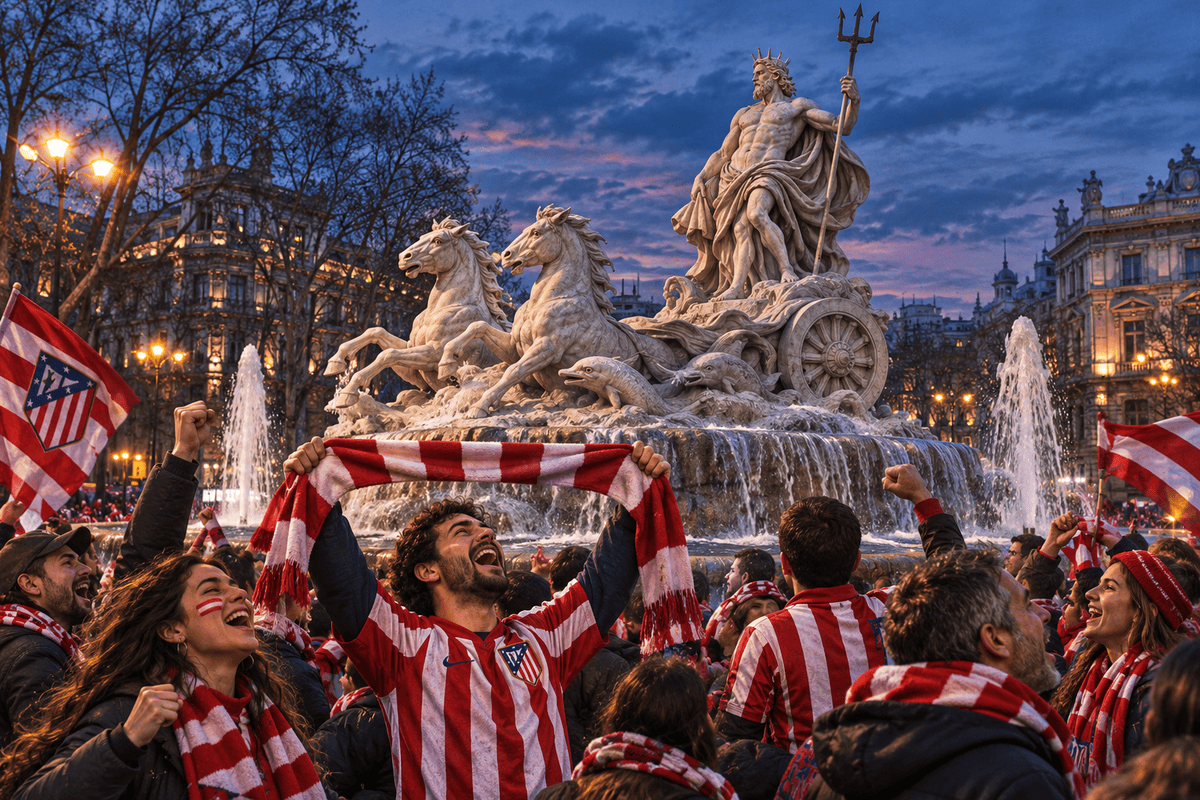
The Fountain of Neptune stands in Plaza de Cánovas del Castillo, on the Paseo del Prado. Walk past on an ordinary morning and you will find traffic circling the statue and people heading towards the museums. On a trophy night the same square becomes a meeting place for Atlético fans who watched the match in different parts of Madrid and want to spend the rest of the evening together.
The two circles on the Paseo del Prado
From Cibeles, walk south past the gardens and museum entrances towards Plaza de Cánovas del Castillo. The distance is short enough to understand the geography of the rivalry on foot. These are two civic monuments on the same boulevard. Their place in football came later, through the habits of people going into the city after matches. At Neptune those habits make a traffic circle legible as a football destination. A visiting supporter who expects club signage may find none in the ordinary street view. The clearest clue is the red and white in the pictures people take there on days when something has been won.
How the square became Atlético’s
The tradition took hold around the back-to-back Copa del Rey wins of 1991 and 1992. Accounts of the earliest visits to Neptune vary, as often happens when a gathering begins with fans turning up of their own accord. The habit is easier to trace than the exact first night: on subsequent occasions, players and supporters kept coming back. The fountain offered a landmark everyone could name and reach, and one distinct from the Cibeles celebrations associated with Real Madrid farther up the same avenue.
Why the cup wins matter
The two cup finals gave supporters repeated reasons to meet in quick succession. Atlético beat Mallorca in the 1991 final and Real Madrid in the 1992 final. On the second occasion the opponent itself gave the celebrations a special resonance in the city. A trophy will bring people outdoors of its own accord, but a tradition needs a place that can work again the next time. Neptune passed that test. Newspaper recollections can differ on the precise starting point. What matters to the story is that the early nineties gave the club's supporters several nights when turning up at the fountain made sense even without being told to go there.
The difference between the match and the celebration
Seat numbers and tickets separate people at a ground. The fountain gathers them according to a different logic. A family that watched the final at home can stand near someone who made it to the stadium and a group that watched from a bar. People arrive at different times and their stories fill in pieces others missed. There are also two different events to keep in mind. An immediate gathering after the whistle can happen hours or a day before any public appearance by the team. Plans around the arrival of players depend on the club and the city, so old photos are a record of a particular occasion rather than a timetable for the next one.
How a visit fits into a day in Madrid
If you are staying near the centre, put Neptune into a walk between the Prado and the streets around the Barrio de las Letras. The wide approaches give you several angles on the fountain. A photograph from the edge of the square can capture the sculpture and enough of the surrounding buildings to recognize the place in later match footage. Cross at the marked crossings and remember that the monument stands inside a busy roundabout. Give yourself time to continue the walk towards Cibeles. Seeing the two monuments in the same afternoon makes their proximity and their different football associations much easier to remember.
Look at the statue as well as the scarves
The fountain's name comes from the figure at the centre of the sculpture. Neptune stands above his chariot with a trident, surrounded by figures associated with the sea. Seen in daylight, it is easier to appreciate how much of the scene is lost when the night photographs are closely cropped around the fans. Use that difference to make two kinds of picture on a visit. One can show the fountain in its setting with the wide streets and the surrounding buildings. The other can pick out the figure that gives the celebration its shorthand name. Together they explain why a chant or a headline can refer to “Neptune” and expect an Atlético supporter to picture a location and a gathering at once.
A story you can see in the photographs
Compare images from different title years. Look beyond the players and banners at the angle of the crowd, the people watching from the edges and the extent to which the surrounding street has filled up. A modern photograph full of raised phones can still preserve recognizable gestures from earlier celebrations: scarves stretched between two hands and groups singing towards the centre. Each picture has a different reason for existing. Taken together, they explain how a city landmark can acquire a second life that becomes visible only when the people who gave it that meaning come back.
Visiting between celebrations
You can see the fountain from the pavements around the square, an easy stop on a walk along the Prado. On a title night, follow local traffic and crowd directions and expect the square to be busy long before any team arrival. What makes Neptune worth seeing even without a trophy procession is how ordinary it feels between celebrations. Madrid goes about its day around a place that, for many Atlético fans, holds several of their happiest football memories.
Sources and further reading · AS · Neptuno · RFEF · Copa del Rey



Comments
No comments yet. Be the first to say what you think.