
Kang-in Lee Is Atlético Madrid’s Next Big Thing
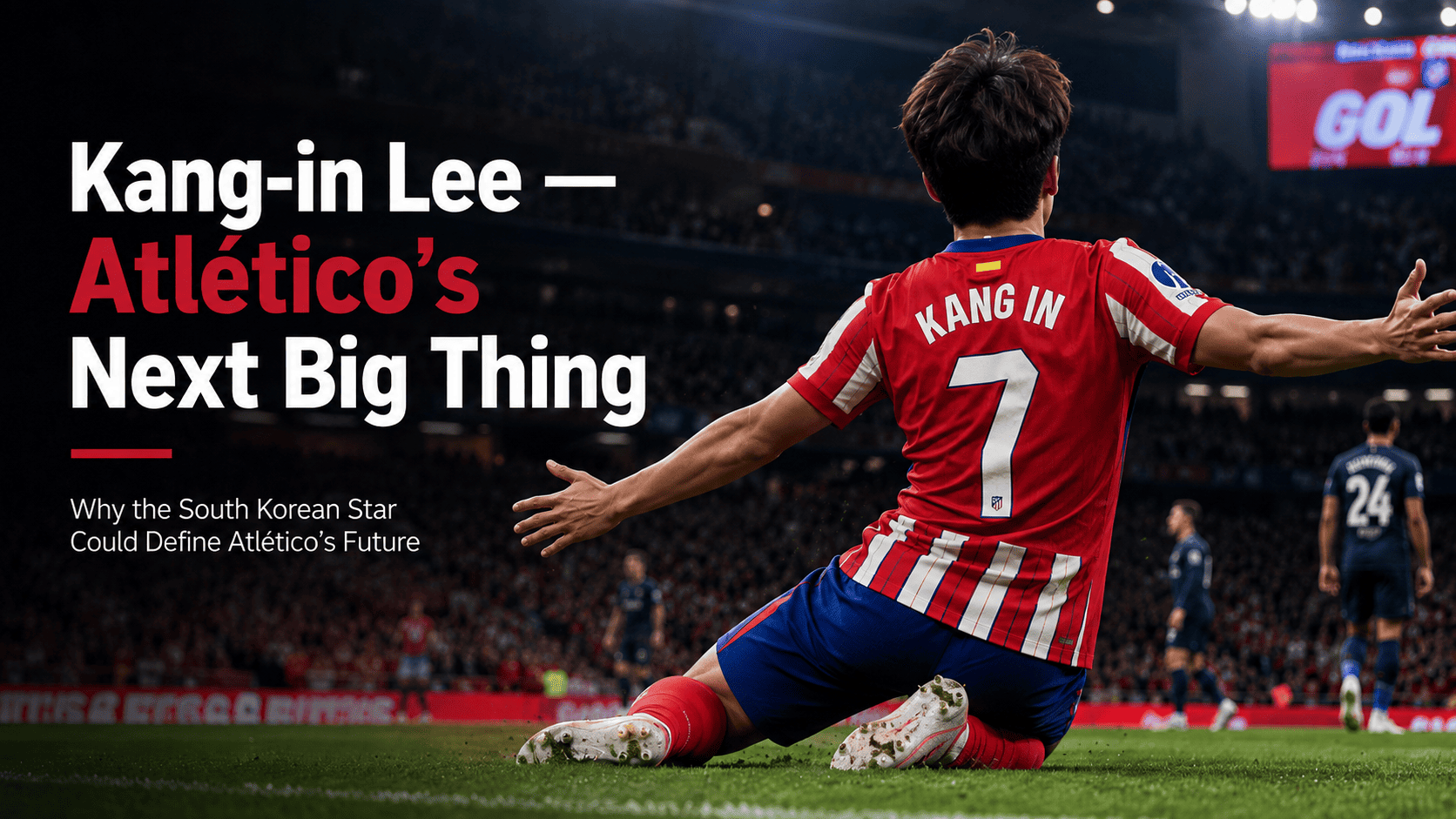
Sometimes a debut gives you a goal.
Sometimes it gives you three points.
And sometimes, if you are paying attention, it gives you a glimpse of what a football team might become.
Kang-in Lee’s first competitive appearance for Atlético Madrid felt like the third kind.
For more than an hour against Málaga, Atlético controlled the ball, controlled the territory and controlled almost everything except the match itself.
Then Lee entered.
Thirteen minutes later, the Metropolitano had its answer.
Kang-in Lee did not simply score Atlético’s first goal of the new LaLiga season. He showed exactly why Atlético Madrid spent the summer bringing him back to Spain.
For 60 Minutes, Atlético Had the Ball — But Not the Solution
The final score says Atlético Madrid 2-0 Málaga.
It looks comfortable.
The match was not.
Málaga arrived at the Metropolitano as a newly promoted side and played like a team with very little interest in becoming part of somebody else’s opening-night celebration.
They remained compact. They protected central spaces. They forced Atlético to circulate the ball around them instead of through them.
Atlético finished with 15 shots to Málaga’s five and an expected-goals advantage of 0.82 to 0.15.
But those numbers also tell part of the problem.
Atlético were dominant without being consistently dangerous.
Possession moved. Players moved. The defensive block often did not.
Lookman, operating through the middle, struggled to influence the game. The young players brought courage and energy, but Atlético lacked somebody capable of receiving in a crowded area and changing the geometry of the attack with one movement.
It was the kind of match Atlético have experienced many times before.
They did not need more possession.
They needed disruption.
Atlético did not need another player to move the ball. They needed someone capable of moving the defence.
Then Kang-in Lee Walked Onto the Pitch
When Lee entered in the second half, the feeling of the match changed almost immediately.
Not because he suddenly transformed Atlético into a completely different team.
Because he gave the team something Málaga had spent the previous hour trying to remove: unpredictability.
Lee wants the ball in places defenders hate.
Not necessarily on the touchline.
Not necessarily with twenty metres of space ahead of him.
He wants it near the edge of the defensive block, where one defender has to decide whether to step forward, another has to decide whether to cover inside, and the entire structure can be disturbed by one touch.
That matters.
Against a deep defence, speed is not always about running faster.
Sometimes speed is the ability to see an opening half a second before everybody else.
Lee has that quality.
The game did not suddenly become more open when Kang-in Lee arrived. He made a closed game feel open.
The Goal Was Beautiful — But It Was Also Tactical
It would be easy to describe the 70th-minute goal simply as individual brilliance.
And it was brilliant.
Lee received on the right side, moved inside, manipulated the defenders in front of him and opened his body onto that left foot.
Then came the finish.
Curl.
Precision.
Top corner.
One of those shots where the goalkeeper understands what is happening slightly before discovering there is absolutely nothing he can do about it.
But there was something more interesting behind the beauty.
After the match, Lee revealed that Simeone had specifically told him there was space between Málaga’s lines.
Receive there.
Look towards goal.
Shoot.
Then Lee went onto the pitch and did almost exactly that.
This was not a random long-range miracle disconnected from the match.
It was the solution to the tactical problem Málaga had presented.
The most exciting thing about Kang-in Lee’s goal was not where the ball finished. It was that he understood exactly where the game wanted him to go.
This Is Why Atlético Wanted Him
Atlético did not sign Kang-in Lee because they needed another traditional winger.
They already have players who can run.
Players who can attack space.
Players who can stretch the pitch.
Lee offers something different.
He is left-footed but naturally dangerous starting from the right.
Give him width and he can deliver.
Allow him inside and he can combine.
Give him space between midfield and defence and he can turn.
Back away from him near the penalty area and he can shoot.
Step towards him and he can release somebody else into the space you just abandoned.
This was one of Atlético’s problems against organised defensive teams.
They could push opponents backwards.
They could establish possession around the penalty area.
But turning territorial control into a clear chance could become painfully difficult.
Lee gives Simeone another answer.
Kang-in Lee is dangerous because every defensive reaction to him potentially creates a different problem somewhere else.
Do Not Call Him the New Griezmann
There is an obvious comparison waiting for him.
Number seven.
Left foot.
Creativity.
Intelligence between the lines.
The ability to turn an ugly Atlético match into something beautiful.
Antoine Griezmann left behind more than a shirt number.
He left behind an enormous creative vacuum.
So when Lee walks onto the Metropolitano pitch wearing seven and bends a left-footed shot into the corner on his league debut, the comparison writes itself.
But Atlético should resist it.
Kang-in Lee does not need to become the next Griezmann.
He needs to become the first Atlético version of Kang-in Lee.
Griezmann became extraordinary because Atlético eventually built relationships around everything he could do.
Lee deserves the opportunity to build his own.
The number seven has a new owner. It does not need a copy of the old one.
Paris Made Him More Complete — Atlético Can Make Him More Important
Lee arrives in Madrid at an interesting point in his career.
He is no longer the teenage prodigy people remember from Valencia.
He is no longer simply the exciting creator who carried so much responsibility at Mallorca.
And he is no longer the talented squad player trying to find a permanent role among PSG’s collection of elite footballers.
Paris gave him something valuable.
Experience at the highest level.
Faster combinations.
Tactical flexibility.
Champions League pressure.
The ability to operate centrally, wide, deeper and closer to goal.
But versatility has a strange danger.
When a player can perform four jobs, coaches sometimes forget to give him one.
Atlético can change that.
Simeone does not need Lee to become a universal substitute who appears wherever somebody else is missing.
He needs to discover the area from which Lee can hurt opponents most often and build from there.
PSG taught Kang-in Lee how to survive among stars. Atlético can give him the chance to become one.
The Right Side Could Become His Laboratory
The right flank may be where the experiment begins.
But calling Lee a right winger does not really explain his football.
He should start there.
He should not be trapped there.
With an overlapping full-back providing width, Lee can move towards the right half-space and receive on his stronger left foot.
From there the possibilities multiply.
Combine through the centre.
Slip a forward through.
Change the point of attack.
Deliver towards the striker.
Or do what Málaga discovered:
allow him half a metre and watch him attack the far corner.
Giuliano Simeone can give Atlético verticality, aggression and relentless running from the same side.
Lee provides another language.
Pause.
Manipulation.
Combination.
Imagination.
The two profiles do not have to cancel each other out.
They give Simeone different weapons for different games.
Some matches need a runner to attack the space. Others need Kang-in Lee to create the space first.
And Yes — He Looks Like a Simeone Player
This will always be the question when Atlético sign a creative footballer.
Can he survive Simeone?
Can he defend?
Can he press?
Can he suffer when Atlético have ten minutes without the ball?
Can he track the full-back after spending the previous attack trying to create something near the opposite penalty area?
Lee will have to prove those things over months, not one night.
But the stereotype of him as simply a luxury technical player has never told the complete story.
At Mallorca he showed he could work.
At PSG he learned to operate within a demanding collective structure.
And against Málaga, he did not enter the game behaving like a superstar waiting for others to give him the ball.
He entered with a specific tactical instruction and attacked the game.
That will please Simeone almost as much as the finish.
Simeone will demand that Lee suffer for Atlético. The challenge is making sure Atlético still allow Lee to create.
One Goal Does Not Make a Superstar
Now comes the necessary warning.
This was Málaga.
This was one match.
This was one substitute appearance.
Football is full of perfect debuts that became ordinary careers.
Atlético have not discovered the next world superstar because one left-footed shot flew into the top corner.
There are still questions.
Can Lee influence matches when he starts rather than entering against tired legs?
Can he produce against elite opposition?
Can he give Atlético eight, ten, twelve decisive goals and assists rather than beautiful moments scattered across a season?
Can he maintain Simeone’s defensive intensity?
Can he become somebody Atlético search for when the match becomes difficult?
Those answers will take months.
But promising players are exciting because of possibilities, not guarantees.
And after Málaga, the possibilities suddenly look enormous.
One night cannot prove Kang-in Lee will become a star. But it can show you why believing it is no longer unreasonable.
The €40 Million Question
Atlético reportedly committed a package worth up to around €40 million to bring Lee from Paris Saint-Germain.
That is not superstar money in modern football.
But it is not experimental money either.
Atlético did not buy a marketing accessory.
They bought a footballer they expect to matter.
His commercial impact in Asia will be enormous.
His shirt will travel.
His name will attract attention far beyond Madrid.
None of that is a problem.
Unless people confuse commercial value with the reason he belongs on the pitch.
Málaga provided the first answer to that argument.
He came on.
He changed the attack.
He scored the decisive goal.
Marketing can introduce a player to millions of people.
Only football can make the Metropolitano believe.
Atlético may have signed Kang-in Lee partly knowing his global value. Against Málaga, he began proving his football value matters even more.
The Most Important Thing Was What Happened After He Entered
Lee scored.
Then Atlético grew.
Hancko hit the crossbar.
Lookman came close.
Álex Baena eventually produced another moment of spectacular quality from a free kick to make it 2-0.
The difference between the uncomfortable Atlético of the first hour and the Atlético finishing the match was obvious.
Better players had entered, yes.
But just as importantly, Málaga suddenly had more questions to answer.
Lee could come inside.
Baena could create.
The ball could move quickly around the edge of the box.
Atlético were no longer simply occupying attacking territory.
They were threatening it.
That distinction may become one of the defining themes of their season.
Kang-in Lee’s greatest value may not be adding another attacker to Atlético. It may be making Atlético’s other attackers more dangerous.
A New Atlético Is Trying to Appear
Atlético Madrid are entering another transition.
Griezmann is gone.
New personalities are arriving.
Younger players are demanding opportunities.
The attacking hierarchy is being rewritten.
And when a great player leaves, clubs often make the mistake of searching for exactly the same player again.
Football does not work that way.
You do not replace history.
You create the next version of the team.
Lee could become an important part of that version.
Not because he will replicate Griezmann’s numbers.
Not because he wears his shirt.
Not because one spectacular goal guarantees anything.
But because Atlético desperately need players who can see solutions where everybody else sees traffic.
Kang-in Lee sees them.
Atlético are searching for a new attacking identity. Kang-in Lee might have just written its first sentence.
Final Thought: Málaga May Have Been the Beginning
In a few months, perhaps we will look back at this match differently.
Maybe it will simply be remembered as a beautiful debut goal against a newly promoted side.
Football allows no guarantees.
But maybe this was the first glimpse.
The first time the Metropolitano saw the left foot.
The first time Atlético needed an idea and Lee provided one.
The first time the number seven appeared inside from the right, looked at the far corner and made thousands of supporters rise before the ball had even finished travelling.
Great Atlético careers have started with less.
Lee still has everything to prove.
That is what makes what comes next so exciting.
Because the technique is there.
The vision is there.
The personality appears to be there.
And now there is a first unforgettable moment.
Kang-in Lee is not Atlético Madrid’s next great player yet. But after one night against Málaga, he suddenly looks capable of becoming exactly that.
More analysis



2026
Comments