
4-3-3 - Diego Simeone's New Weapon
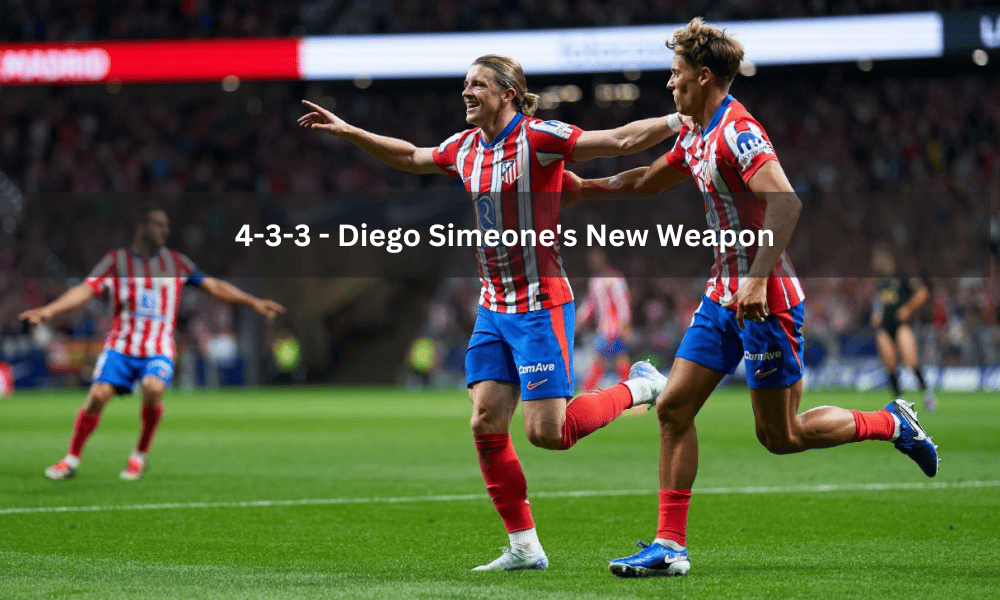
Years ago, it was hard to believe Diego Simeone would ever use a formation
other than the classic 4-4-2. However, as the trend in recent seasons continues,
he is open to adapting based on the qualities of the players at his disposal.
Of course, this is not a permanent setup; against strong teams, we most often play
4-4-2 in a low block or transitioning 3-5-2 to 5-3-2 (5-4-1). Yet currently, Simeone
seems to have found a "cure" for easier wins against less demanding opponents. Over
the years, Atlético has struggled when the initiative was entirely on our side and
we failed to win matches, as seen in this year’s game against Espanyol.
Who Are the Ideal Players for This Setup?
Yesterday against Sparta Praha, we saw an interesting approach. First, Griezmann was
on the bench. Second, in a setup with a back four, we started with our most dynamic
full-backs Galán and Llorente, even though Llorente is far from being a classic
full-back. The second surprise, albeit not entirely unexpected, was captain Koke on
the bench, with his duties taken over by Pablo Barrios, who is by no means a classic
defensive midfielder. Instead, we played with midfielders who had both defensive
and attacking responsibilities in nearly equal measure. Barrios, Gallagher, and
De Paul fit the profile of box-to-box midfielders. The main change was attacking
with three forwards, each with a different role. Giuliano aimed to make direct runs
and overlap with Llorente on the right, targeting Sparta's left wing-back and
left-sided center-back. Sorloth, naturally, acted as the classic target man, while
Álvarez played with the most freedom, functioning as a left inside-forward cutting
into the center. The left flank, as usual, was often left entirely to Javi Galán,
who excelled in both phases of the game, possessing the speed and endurance for
such a role.
How Is the 4-3-3 Formation Beneficial for the Team?
As evident from the previous paragraph, the team's attacking power is greatly
enhanced and diversified. Moreover, when positioned higher up the pitch, with
more players in advanced positions, the team can recover the ball quicker and
higher up the field, leading to more frequent attacks. In this style of play, it
is crucial to prevent quick counterattacks from the opponent, intercepting them
early. However, we know this isn't possible every time, so the three central
midfielders must provide good coverage, and the defenders need speed. Witsel,
for example, struggles more if the opponent launches quick, effective counters.
Yet, this formation can make our team much more dominant in matches against weaker
opponents, allowing us to win with greater ease than ever before.
Learn more about Pablo Barrios's game in this
analysis.
Is There Room for Griezmann and Koke in This Formation?
Absolutely. Griezmann, in particular, can be valuable in two positions: as the third,
most offensive midfielder, or as the forward with a freer role, seeking spaces
between the lines in the opponent's half. As for captain Koke, it’s clear that he
would provide additional security in ball recovery and efficient distribution during
attacks.
Does the Team Have a Future With This Formation?
Yes. From what we’ve observed this season, the formation is excellent for matches
against weaker opponents, ensuring easier victories. Against stronger and more
offensively oriented teams, it’s currently not viable. For better success with this
formation, the team needs more speed in central defense and midfield, especially a
quick, classic defensive midfielder who can cover a large area. However, at this
stage of the team’s development, this is an ideal weapon against weaker opponents,
especially allowing freedom to Álvarez, who is highly unpredictable and dangerous
from various positions.
Learn more about the predictions and analysis for Atlético Madrid’s final seven
matches of the year in this
analysis.
More analysis

2026
Comments